
Im Journal of Independent Medicine erschien eine dreiteilige Reihe über die Vorherige Immunität gegen COVID-19, die von der Politik immer bestritten wurde.
Die Übersichtsartikel bestehen aus drei Teilen:
Teil 1: Vorimmunität durch andere Coronaviren gegen SARS-CoV-2
Nicoll, R. (2025). Pre-existing Immunity to COVID-19: Overview and Implications – Part 1. Journal of Independent Medicine, 201–213. https://doi.org/10.71189/JIM/2025/V01N03A04
https://journalofindependentmedicine.org/articles/v01n03a04/
Teil 2: Vorimmunität durch andere Mikroorganismen
Nicoll, R. (2026). Pre-existing Immunity to COVID-19: Overview and Implications – Part 2. Journal of Independent Medicine, 25–30. https://doi.org/10.71189/JIM/2026/V02N01A03
https://journalofindependentmedicine.org/articles/v02n01a03/
Teil 3: Vorimmunität durch Nicht-COVID-Impfungen
Nicoll, R. (2026). Pre-existing Immunity to COVID-19: Overview and Implications – Part 3. Journal of Independent Medicine, 111–119. https://doi.org/10.71189/JIM/2026/V02N02A04
https://journalofindependentmedicine.org/articles/v02n02a04/
Die Artikel sind frei zugänglich. Man muss sich nur kostenlos beim Journal anmelden und bekommt Emails, wenn eine neue Ausgabe raus ist.
Für all jene, die kein Englisch können, oder sich nicht anmelden wollen, fasse ich die Highlights der Artikel zusammen.
Ich hatte einige Publikationen in meiner Sammlung, die schon sehr früh zeigten, dass ein Großteil der Bevölkerung Kreuzimmun war. Die Menge an Daten, die teils schon sehr früh vorhanden war, hat selbst mich überrascht. Ich habe die Referenzen daher in die Fußnoten übertragen.
Teil 1: Vorimmunität durch andere Coronaviren gegen SARS-CoV-2
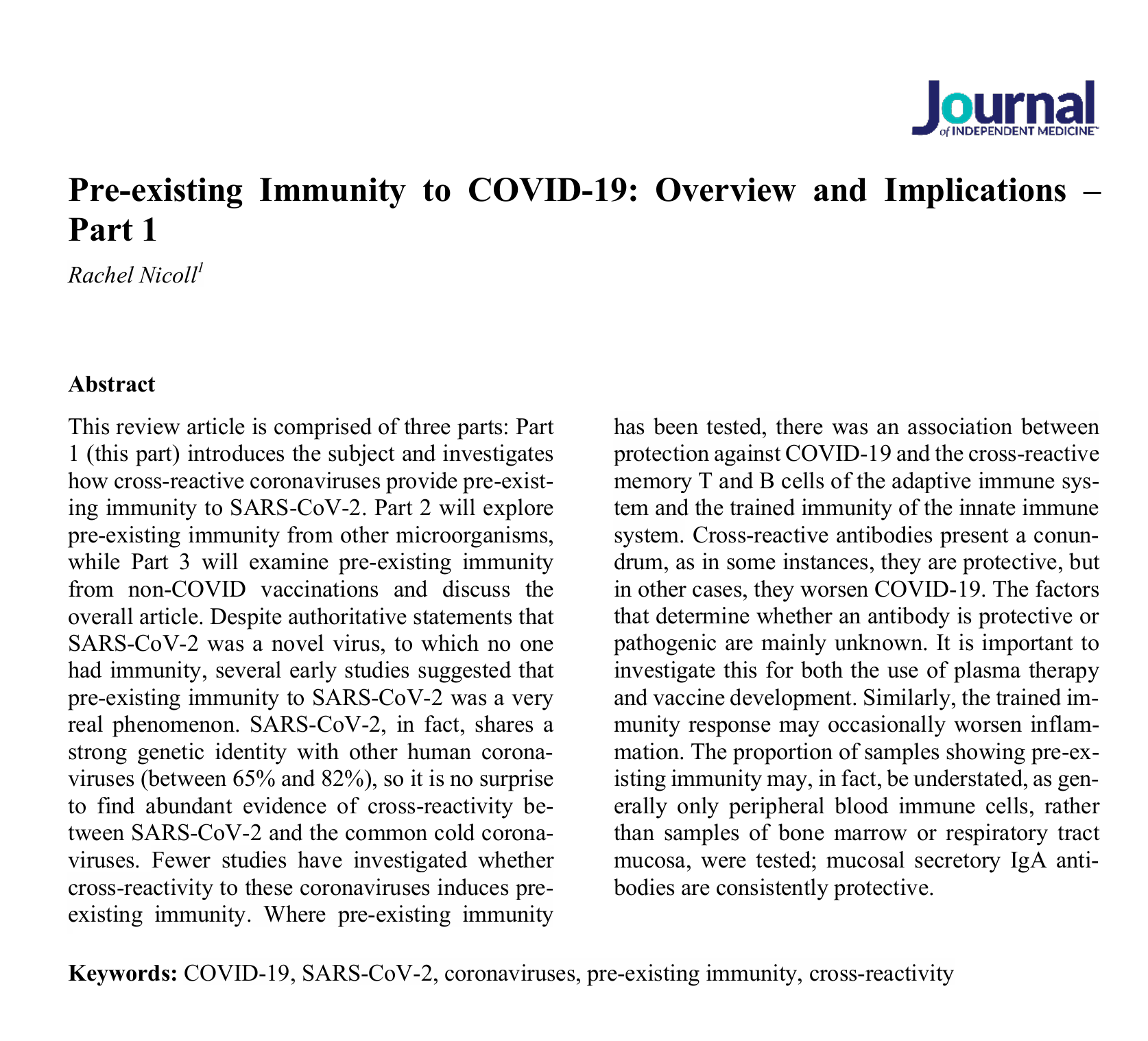
Trotz maßgeblicher Aussagen, dass SARS-CoV-2 ein neuartiges Virus sei, gegen das niemand Immunität besitze, deuteten mehrere frühe Studien darauf hin, dass eine bereits bestehende Immunität gegen SARS-CoV-2 ein sehr reales Phänomen sei. SARS-CoV-2 weist tatsächlich eine starke genetische Übereinstimmung mit anderen humanen Coronaviren auf (zwischen 65 % und 82 %), sodass es nicht überrascht, zahlreiche Hinweise auf eine Kreuzreaktivität zwischen SARS-CoV-2 und den Coronaviren der Erkältung zu finden. Weniger Studien haben untersucht, ob eine Kreuzreaktivität mit diesen Coronaviren eine bereits bestehende Immunität induziert. Wo eine vorbestehende Immunität untersucht wurde, bestand ein Zusammenhang zwischen dem Schutz vor COVID-19 und den kreuzreaktiven Gedächtnis-T- und -B-Zellen des adaptiven Immunsystems sowie der trainierten Immunität des angeborenen Immunsystems. Kreuzreaktive Antikörper stellen ein Dilemma dar, da sie in einigen Fällen schützend wirken, in anderen Fällen jedoch den Verlauf von COVID-19 verschlimmern. Die Faktoren, die bestimmen, ob ein Antikörper schützend oder pathogen ist, sind größtenteils unbekannt. Es ist wichtig, dies sowohl für den Einsatz der Plasmatherapie als auch für die Impfstoffentwicklung zu untersuchen. Ebenso kann die trainierte Immunantwort gelegentlich Entzündungen verschlimmern. Der Anteil der Proben, die eine vorbestehende Immunität aufweisen, könnte tatsächlich unterschätzt werden, da im Allgemeinen nur Immunzellen aus dem peripheren Blut und nicht Proben aus dem Knochenmark oder der Schleimhaut der Atemwege getestet wurden; sekretorische IgA-Antikörper der Schleimhaut wirken durchweg schützend.
Adaptives Immunsystem: T-Zellen
Zahlreiche Studien haben gezeigt, dass Serum aus der Zeit vor der Pandemie Gedächtnis-CD4+- und CD8+-T-Zellen enthält, die mit SARS-CoV-2 kreuzreagieren und gegen hochkonservierte, gemeinsame Coronavirus-Epitope gerichtet sind. Eine Analyse der Studien, die ausreichend detaillierte Angaben liefern, zeigt, dass Schmidt et al. an den beiden Extremen bei 17,4 % von 23 gesunden Spendern kreuzreaktive T-Zellen nachweisen konnten. Gleichzeitig zeigten Lineburg et al., dass T-Zellen von 90 % von 23 nicht exponierten Spendern ein Schlüsselprotein von SARS-CoV-2 erkannten. Die übrigen Studien ergaben Anteile zwischen 18 % und 90 %, die je nach dem ursprünglichen Coronavirus und der Art der T-Zellen (CD4+ oder CD8+) variieren können [18–44]. Einige dieser Studien wurden zu Beginn der Pandemie veröffentlicht, wie beispielsweise die von Grifoni et al. und Weiskopf et al., beide aus dem Juni 2020.
Kreuzreaktivität bedeutet nicht zwangsläufig Immunität, auch wenn es nicht abwegig wäre, dies anzunehmen. Unter den Studien, die sich mit dem Schutz vor SARS-CoV-2 befassen, haben einige einen umgekehrten Zusammenhang zwischen kreuzreaktiven Gedächtnis-T-Zellen und der Häufigkeit oder Schwere von COVID-19 aufgezeigt, wobei kreuzreaktive T-Zellen bei Patienten mit mildem oder asymptomatischem Krankheitsverlauf im Vergleich zu Patienten mit schwerem Krankheitsverlauf in größerer Zahl vorhanden waren [45-51].
Mehrere Studien haben die entscheidende Rolle des sekretorischen IgA (sIgA) der Schleimhäute beim Schutz vor SARS-CoV-2 und anderen Atemwegsinfektionen hervorgehoben, wobei es eine stärkere Neutralisierungsfähigkeit aufweist als IgG.
Mehrere Studien haben gezeigt, dass die Mehrheit der Epitope für kreuzreaktive T-Zellen in anderen SARS-CoV-2-Proteinen als dem Spike-Protein identifiziert wurde.
Das ist immunologische Flexibilität. Das Spike-Protein mag mutieren, es sind noch genug Proteine da, um das Virus zu erkennen. Das kann eine Impfung nicht leisten. Das zeigt aber auch, wie dumm die Wahl des Spike-Proteins als Antigen/Immunogen war.
Angesichts der Vielzahl gemeinsamer Peptidsequenzen lässt dies vermuten, dass die Identifizierung von Kreuzreaktivität deutlich häufiger vorkommen könnte, wenn alle möglichen Peptide berücksichtigt würden, und dass bereits bestehende Immunität auch dann vorliegen könnte, wenn aufgrund der unzureichenden Anzahl getesteter Proteine keine offensichtliche Kreuzreaktivität feststellbar ist.
Man findet nur, was man sucht, und wenn man nicht finden will, dann wird man nicht fündig werden.
Adaptives Immunsystem: B-Zellen
Mehrere Studien haben gezeigt, dass Gedächtnis-B-Zellen zwischen SARS-CoV-2 und anderen humanen Coronaviren kreuzreaktiv sind [64–71]. Auch hier gilt: Wenn der Anteil der Probanden mit bereits vorhandenen kreuzreaktiven Gedächtnis-B-Zellen gering erscheint, könnte dies daran liegen, dass lediglich das Spike-Protein untersucht wurde. Im Gegensatz dazu lassen sich kreuzreaktive B-Zellen gegen das SARS-CoV-2-Nukleokapsidprotein in einem signifikanten Anteil von Blutproben aus der Zeit vor der Pandemie nachweisen. Dennoch scheinen kreuzreaktive Gedächtnis-B-Zellen, die gegen das Spike-Protein gerichtet sind, Serumantikörper mit begrenztem Virusneutralisationspotenzial zu produzieren.
Adaptives Immunsystem: Antikörper
Einige Studien zeigen, dass die Konzentration von Antikörpern gegen das humane Coronavirus bei asymptomatischen oder leicht erkrankten COVID-19-Patienten signifikant höher ist als bei Patienten mit schwerem oder tödlichem Verlauf ,83-85 116–118, was auf eine schützende Wirkung hindeutet, während andere keinen Zusammenhang mit der COVID-19-Inzidenz oder dem Schweregrad feststellen oder die Studien eine Korrelation mit erhöhtem Schweregrad zeigen
Der Einfluss des Alters
Vorbestehende kreuzreaktive T-Zell-Reaktionen auf das Spike-Protein waren bei Kindern mehr als doppelt so hoch wie bei Erwachsenen, wobei die Qualität der kreuzreaktiven T-Zellen im Alter von 6 Jahren ihren Höhepunkt erreichte und mit zunehmendem Alter abnahm . Wie bei den T-Zellen wiesen Kinder im Vergleich zu Erwachsenen eine höhere Häufigkeit kreuzreaktiver Gedächtnis-B-Zellen auf.
Darüber hinaus weisen Kinder möglicherweise eine geringere Expression des ACE2-Rezeptors in den unteren Atemwegen auf – dem primären Eintrittsweg von SARS-CoV-2 in den Körper –, eine geringere Produktion von Entzündungszytokinen, was den Schweregrad von COVID-19 beeinflussen kann, sowie ein vielfältigeres T-Zell-Rezeptor-Repertoire im Vergleich zu älteren Menschen.
Im Alter von 10 Jahren haben Kinder Antikörper gegen das Spike-Protein aller vier endemischen Erkältungs-Coronaviren gebildet, wobei die Seroprävalenz bei 75,84 % liegt . Im Vergleich zu Erwachsenen sind sie zu einer wesentlich breiteren Antikörperreaktion gegen das Spike-Protein fähig. Dennoch wiesen Kinder im Vergleich zu Erwachsenen niedrigere Antikörperspiegel gegen die Spike- und Nukleokapsidproteine auf, könnten jedoch höhere Antikörperspiegel gegen nichtstrukturelle Proteine aufweisen; auch hier werden diese in Kreuzreaktivitätsstudien, die sich ausschließlich auf das Spike-Protein konzentrieren, übersehen. Die meisten Studien deuten darauf hin, dass sich die Konzentrationen kreuzreaktiver Antikörper mit dem Alter verändern .
Die hier zitierten Quellen zum Einfluss des Altern sind aus meist aus den Jahren 2020, 2021. Damit war bereits zu diesem Zeitpunkt klar, die Kinder reagieren deutlich besser als Erwachsene. Dennoch bezeichnete Bömerman sie in Deutschland als Ratten, die Krankheiten übertragen und Politiker machten ihnen Angst, dass sie Erwachsene anstecken und töten könnten. Immunologisch vollkommen unbegründet.
Für mich mit der wichtigste Teil des Übersichtsartikels, der alle Maßnahmen, die man gegen Kinder ergriffen hat, umso verbrecherischer macht.
Teil 1 – Schlussfolgerung
Obwohl der Generaldirektor der WHO behauptete, SARS-CoV-2 sei ein neues Virus, gegen das niemand Immunität besitze, stellte sich dies schnell als falsch heraus. Das Virus war SARS-CoV-1 und anderen Coronaviren, die beim Menschen Erkältungen verursachen, sowohl genetisch als auch hinsichtlich des Eindringens in den Körper sehr ähnlich. Studien zeigten schnell, dass viele Menschen eine Kreuzreaktivität gegenüber SARS-CoV-2 aufwiesen, was ihnen möglicherweise auch Immunität verliehen hatte. In ähnlicher Weise behandelte auch das Modell des Imperial College SARS-CoV-2 in den ersten Vorhersagen als neuartiges Virus.
Das Alter kann die Schutzwirkung der Kreuzreaktivität beeinflussen, wobei Kinder im Vergleich zu älteren Menschen einen deutlich stärkeren Schutz vor einer COVID-19-Erkrankung und deren schweren Verlauf aufweisen.
Schmidt KG, Nganou-Makamdop K, Tenbusch M, El Kenz B, Maier C, Lapuente D, Überla K, Spriewald B, Bergmann S, Harrer EG, Harrer T. SARS-CoV-2-Seronegative Subjects Target CTL Epitopes in the SARS-CoV-2 Nucleoprotein Cross-Reactive to Common Cold Coronaviruses. Front Immunol. 2021 Apr 28;12:627568. doi: 10.3389/fimmu.2021.627568. PMID: 33995351; PMCID: PMC8113865. https://pubmed.ncbi.nlm.nih.gov/33995351/
Lineburg KE, Grant EJ, Swaminathan S, Chatzileontiadou DSM, Szeto C, Sloane H, Panikkar A, Raju J, Crooks P, Rehan S, Nguyen AT, Lekieffre L, Neller MA, Tong ZWM, Jayasinghe D, Chew KY, Lobos CA, Halim H, Burrows JM, Riboldi-Tunnicliffe A, Chen W, D’Orsogna L, Khanna R, Short KR, Smith C, Gras S. CD8+ T cells specific for an immunodominant SARS-CoV-2 nucleocapsid epitope cross-react with selective seasonal coronaviruses. Immunity. 2021 May 11;54(5):1055-1065.e5. doi: 10.1016/j.immuni.2021.04.006. Epub 2021 Apr 13. PMID: 33945786; PMCID: PMC8043652. https://pubmed.ncbi.nlm.nih.gov/33945786/
18. Saletti G, Gerlach T, Jansen JM, Molle A, El bahesh H, Ludlow M, et al. Older adults lack SARS CoV-2 cross-reactive T lymphocytes di- . rected to human coronaviruses OC43 and NL63. Sci Rep. 2020 Dec 8;10(1):21447
19. Brodin P. Why is COVID-19 so mild in chil dren? Acta Paediatr (2020) 109:1082–3
20. Grifoni A, Weiskopf D, Ramirez SI, Mateus J, Dan JM, Moderbacher CR, et al. Targets of T Cell Responses to SARS-CoV-2 Coronavirus in Humans with COVID-19 Disease and Un exposed Individuals. 25;181(7):1489-1501 Cell. 2020 Jun
21. Weiskopf D, Schmitz KS, Raadsen MP, Gri foni A, Okba NMA, Endeman H, et al. Pheno type and kinetics of SARS-CoV-2-specific T cells in COVID-19 patients with acute respira tory distress syndrome. Sci Immunol. 2020 Jun 26;5(48):eabd2071
22. Braun J, Loyal L, Frentsch M, Wendisch D, Georg P, Kurth F, et al. SARS-CoV-2-reactive T cells in healthy donors and patients with COVID-19. Nature. 2020 Nov;587(7833): 270-274
23. Le Bert N, Tan AT, Kunasegaran K, Tham CYL, Hafezi M, Chia A, et al. SARS-CoV-2 specific T cell immunity in cases of COVID 19 and SARS, and uninfected controls. Nature. 2020 Aug;584(7821):457-462
24. No authors listed. SARS-CoV-2-cross-reactive T cells identified in pre-pandemic lower air way samples. Nat Immunol. 2022 Sep;23(9): 1307-1308
25. Diniz MO, Mitsi E, Swadling L, Rylance J, Johnson M, Goldblatt D, et al. Airway-resident T cells from unexposed individuals cross-rec ognize SARS-CoV-2. Nat Immunol. 2022 Sep;23(9):1324-1329.
26. Hyun YS, Lee YH, Jo HA, Baek IC, Kim SM, Sohn HJ, et al. Comprehensive Analysis of CD4+ T Cell Response Cross-Reactive to SARS-CoV-2 Antigens at the Single Allele Level of HLA Class II. Front Immunol. 2022 Jan 6;12:774491
27. Mathew S, Fakhroo AD, Smatti M, Al Thani AA, Yassine HM. Immunoinformatics predic tion of potential immunodominant epitopes from human coronaviruses and association with autoimmunity. Immunogenetics. 2022 Apr;74(2):213-229
28. García-Jiménez ÁF, Cáceres-Martell Y, Fer nández-Soto D, Martínez Fleta P, Casasnovas JM, Sánchez-Madrid F, et al. Cross-reactive cellular, but not humoral, immunity is detected between OC43 and SARS-CoV-2 NPs in peo ple not infected with SARS-CoV-2: Possible role of cTFH cells. J Leukoc Biol. 2022 Aug;112(2):339-346 J Indep Med 2025 Vol. 1 No. 3
29. Becerra-Artiles A, Nanaware PP, Muneeruddin K, Weaver GC, Shaffer SA, Calvo-Calle JM, et al. Immunopeptidome profiling of human coronavirus OC43-infected cells identifies CD4 T-cell epitopes specific to seasonal coro naviruses or cross-reactive with SARS-CoV-2. PLoS Pathog. 2023 Jul 27;19(7):e1011032
30. Loyal L, Braun J, Henze L, Kruse B, Dingeldey M, Reimer U, et al. Cross-reactive CD4+ T cells enhance SARS-CoV-2 immune responses upon infection and vaccination. Sci ence. 2021 Oct 8;374(6564):eabh1823
31. Cassaniti I, Percivalle E, Bergami F, Piralla A, Comolli G, Bruno R, et al. SARS-CoV-2 spe cific T-cell immunity in COVID-19 convales cent patients and unexposed controls measured by ex vivo ELISpot assay. Clin Microbiol In fect. 2021 Jul;27(7):1029-1034
32. Gallais F, Velay A, Nazon C, Wendling MJ, Partisani M, Sibilia J, et al. Intrafamilial Expo sure to SARS-CoV-2 Associated with Cellular Immune Response without Seroconversion, France. Emerg Infect Dis. 2021 Jan;27(1):113 21
33. Echeverría G, Guevara Á, Coloma J, Ruiz AM, Vasquez MM, Tejera E, et al. Pre-existing T cell immunity to SARS-CoV-2 in unexposed healthy controls in Ecuador, as detected with a COVID-19 Interferon-Gamma Release Assay. Int J Infect Dis. 2021 Apr;105:21-25
34. Saini SK, Hersby DS, Tamhane T, Povlsen HR, Amaya Hernandez SP, Nielsen M, et al. SARS CoV-2 genome-wide T cell epitope mapping reveals immunodominance and substantial CD8+ T cell activation in COVID-19 patients. Sci Immunol. 2021 Apr 14;6(58):eabf7550
35. Niessl J, Sekine T, Lange J, Konya V, Forkel M, Maric J, et al. Identification of resident memory CD8+ T cells with functional speci ficity for SARS-CoV-2 in unexposed oropha ryngeal lymphoid tissue. Sci Immunol. 2021 Oct 22;6(64):eabk0894
36. Sekine T, Perez-Potti A, Rivera-Ballesteros O, Strålin K, Gorin JB, Olsson A, et al. Robust T Cell Immunity in Convalescent Individuals with Asymptomatic or Mild COVID-19. Cell. 2020 Oct 1;183(1):158-168.e14
37. Bacher P, Rosati E, Esser D, Martini GR, Sag gau C, Schiminsky E, et al. Low-Avidity CD4+ T Cell Responses to SARS-CoV-2 in Unexposed Individuals and Humans with Se vere COVID-19. Immunity. 2020 Dec 15;53(6):1258-1271.e5
38. Steiner S, Sotzny F, Bauer S, Na IK, Schmueck-Henneresse M, Corman VM, et al. . 207 https://doi.org/10.71189/JIM/2025/V01N03A04 HCoV- and SARS-CoV-2 Cross-Reactive T Cells in CVID Patients. Front Immunol. 2020 Dec 23;11:607918
39. Woldemeskel BA, Kwaa AK, Garliss CC, Lae yendecker O, Ray SC, Blankson JN. Healthy donor T cell responses to common cold coro naviruses and SARS-CoV-2. J Clin Invest. 2020 Dec 1;130(12):6631-6638
40. Kim SH, Kim Y, Jeon S, Park U, Kang JI, Jeon K, et al. Rise in broadly cross-reactive adaptive immunity against human β-coronaviruses in MERS-recovered patients during the COVID 19 pandemic. Sci Adv. 2024 Mar;10(9): eadk6425.
41. Richards KA, Glover M, Crawford JC, Thomas PG, White C, Sant AJ. Circulating CD4 T Cells Elicited by Endemic Corona viruses Display Vast Disparities in Abundance and Functional Potential Linked to Antigen Specificity and Age. J Infect Dis. 2021 May 20;223(9):1555-1563
42. Li J, Reinke S, Shen Y, Schollmeyer L, Liu YC, Wang Z, et al. A ubiquitous bone marrow reservoir of preexisting SARS-CoV-2-reactive memory CD4+ T lymphocytes in unexposed individuals. Front Immunol. 2022 Oct 4;13:1004656
43. Mahajan S, Kode V, Bhojak K, Karunakaran C, Lee K, Manoharan M, et al. Immunodomi nant T-cell epitopes from the SARS-CoV-2 spike antigen reveal robust pre-existing T-cell immunity in unexposed individuals. Sci Rep. 2021 Jun 23;11(1):13164
44. Ogbe A, Kronsteiner B, Skelly DT, Pace M, Brown A, Adland E, et al. T cell assays differ entiate clinical and subclinical SARS-CoV-2 infections from cross-reactive antiviral re sponses. Nat Commun. 2021 Apr 6;12(1):2055
Grifoni A, Weiskopf D, Ramirez SI, Mateus J, Dan JM, Moderbacher CR, Rawlings SA, Sutherland A, Premkumar L, Jadi RS, Marrama D, de Silva AM, Frazier A, Carlin AF, Greenbaum JA, Peters B, Krammer F, Smith DM, Crotty S, Sette A. Targets of T Cell Responses to SARS-CoV-2 Coronavirus in Humans with COVID-19 Disease and Unexposed Individuals. Cell. 2020 Jun 25;181(7):1489-1501.e15. doi: 10.1016/j.cell.2020.05.015. Epub 2020 May 20. PMID: 32473127; PMCID: PMC7237901. https://pubmed.ncbi.nlm.nih.gov/32473127/
Weiskopf D, Schmitz KS, Raadsen MP, Grifoni A, Okba NMA, Endeman H, van den Akker JPC, Molenkamp R, Koopmans MPG, van Gorp ECM, Haagmans BL, de Swart RL, Sette A, de Vries RD. Phenotype and kinetics of SARS-CoV-2-specific T cells in COVID-19 patients with acute respiratory distress syndrome. Sci Immunol. 2020 Jun 26;5(48):eabd2071. doi: 10.1126/sciimmunol.abd2071. PMID: 32591408; PMCID: PMC7319493. https://pubmed.ncbi.nlm.nih.gov/32591408/
Murray SM, Ansari AM, Frater J, Klenerman P, Dunachie S, Barnes E, Ogbe A. The impact of pre-existing cross-reactive immunity on SARS-CoV-2 infection and vaccine responses. Nat Rev Immunol. 2023 May;23(5):304-316. doi: 10.1038/s41577-022-00809-x. Epub 2022 Dec 20. PMID: 36539527; PMCID: PMC9765363. https://pubmed.ncbi.nlm.nih.gov/36539527/
Loyal L, Braun J, Henze L, Kruse B, Dingeldey M, Reimer U, Kern F, Schwarz T, Mangold M, Unger C, Dörfler F, Kadler S, Rosowski J, Gürcan K, Uyar-Aydin Z, Frentsch M, Kurth F, Schnatbaum K, Eckey M, Hippenstiel S, Hocke A, Müller MA, Sawitzki B, Miltenyi S, Paul F, Mall MA, Wenschuh H, Voigt S, Drosten C, Lauster R, Lachman N, Sander LE, Corman VM, Röhmel J, Meyer-Arndt L, Thiel A, Giesecke-Thiel C. Cross-reactive CD4+ T cells enhance SARS-CoV-2 immune responses upon infection and vaccination. Science. 2021 Oct 8;374(6564):eabh1823. doi: 10.1126/science.abh1823. Epub 2021 Oct 8. PMID: 34465633; PMCID: PMC10026850. https://pubmed.ncbi.nlm.nih.gov/34465633/
45.Sagar M, Reifler K, Rossi M, Miller NS, Sinha P, White LF, et al. Recent endemic coronavirus infection is associated with less-severe COVID-19. J Clin Invest. 2021 Jan 4;131(1):e143380
46. Fillmore NR, Szalat RE, La J, Branch-Elliman W, Monach PA, Nguyen V, et al. Recent com mon human coronavirus infection protects against severe acute respiratory syndrome coronavirus 2 (SARS-CoV-2) infection: A Vet erans Affairs cohort study. Proc Natl Acad Sci U S A. 20 Nov 16;119(46):e2213783119
47. Odendahl M, Endler I, Haubold B, Rodionov RN, Bornstein SR, Tonn T. SARS-CoV-2 specicific humoral immunity in convalescent patients with mild COVID-19 is supported by CD4+ T-cell help and negatively correlated . 208 with Alphacoronavirus-specific antibody titer. Immunol Lett. 2022 Dec;251-252:38-46
48. Casado JL, Häemmerle J, Vizcarra P, Velasco H, Velasco T, Fernandez-Escribano M, et al. SARS CoV-2 infections in healthcare workers with a pre-existing T-cell response: a prospec tive cohort study. Clin Microbiol Infect. 2021 Jun;27(6):916.e1-916.e4
49. Kundu R, Narean JS, Wang L, Fenn J, Pillay T, Fernandez ND, et al. Cross-reactive memory T cells associate with protection against SARS CoV-2 infection in COVID-19 contacts. Nat Commun. 2022 Jan 10;13(1):80.
50. Nelson RW, Chen Y, Venezia OL, Majerus RM, Shin DS; MGH COVID-19 Collection & Processing Team; et al. SARS-CoV-2 epitope specific CD4+ memory T cell responses across COVID-19 disease severity and antibody du rability. Sci Immunol. 2022 Jul 22;7(73): eabl9464
51. Swadling L, Diniz MO, Schmidt NM, Amin OE, Chandran A, Shaw E, et al. Pre-existing polymerase-specific T cells expand in abortive seronegative SARS-CoV-2. Nature. 2022 Jan;601(7891):110-117
Sinha D, Yaugel-Novoa M, Waeckel L, Paul S, Longet S. Unmasking the potential of secretory IgA and its pivotal role in protection from respiratory viruses. Antiviral Res. 2024 Mar;223:105823. doi: 10.1016/j.antiviral.2024.105823. Epub 2024 Feb 6. PMID: 38331200. https://pubmed.ncbi.nlm.nih.gov/38331200/
Zhang G, Huang P, Yuan H, Li E, Chi X, Sun H, Han J, Fang T, Dong Y, Li J, Wang Y, Li J, Chiu S, Yu C. Nasal delivery of secretory IgA confers enhanced neutralizing activity against Omicron variants compared to its IgG counterpart. Mol Ther. 2025 Apr 2;33(4):1687-1700. doi: 10.1016/j.ymthe.2025.02.041. Epub 2025 Mar 1. PMID: 40025736; PMCID: PMC11997491. https://pubmed.ncbi.nlm.nih.gov/40025736/
Murray SM, Ansari AM, Frater J, Klenerman P, Dunachie S, Barnes E, Ogbe A. The impact of pre-existing cross-reactive immunity on SARS-CoV-2 infection and vaccine responses. Nat Rev Immunol. 2023 May;23(5):304-316. doi: 10.1038/s41577-022-00809-x. Epub 2022 Dec 20. PMID: 36539527; PMCID: PMC9765363. https://pubmed.ncbi.nlm.nih.gov/36539527/
Grifoni A, Weiskopf D, Ramirez SI, Mateus J, Dan JM, Moderbacher CR, Rawlings SA, Sutherland A, Premkumar L, Jadi RS, Marrama D, de Silva AM, Frazier A, Carlin AF, Greenbaum JA, Peters B, Krammer F, Smith DM, Crotty S, Sette A. Targets of T Cell Responses to SARS-CoV-2 Coronavirus in Humans with COVID-19 Disease and Unexposed Individuals. Cell. 2020 Jun 25;181(7):1489-1501.e15. doi: 10.1016/j.cell.2020.05.015. Epub 2020 May 20. PMID: 32473127; PMCID: PMC7237901. https://pubmed.ncbi.nlm.nih.gov/32473127/
Ogbe A, Kronsteiner B, Skelly DT, Pace M, Brown A, Adland E, Adair K, Akhter HD, Ali M, Ali SE, Angyal A, Ansari MA, Arancibia-Cárcamo CV, Brown H, Chinnakannan S, Conlon C, de Lara C, de Silva T, Dold C, Dong T, Donnison T, Eyre D, Flaxman A, Fletcher H, Gardner J, Grist JT, Hackstein CP, Jaruthamsophon K, Jeffery K, Lambe T, Lee L, Li W, Lim N, Matthews PC, Mentzer AJ, Moore SC, Naisbitt DJ, Ogese M, Ogg G, Openshaw P, Pirmohamed M, Pollard AJ, Ramamurthy N, Rongkard P, Rowland-Jones S, Sampson O, Screaton G, Sette A, Stafford L, Thompson C, Thomson PJ, Thwaites R, Vieira V, Weiskopf D, Zacharopoulou P; Oxford Immunology Network Covid-19 Response T Cell Consortium; Oxford Protective T Cell Immunology for COVID-19 (OPTIC) Clinical Team; Turtle L, Klenerman P, Goulder P, Frater J, Barnes E, Dunachie S. T cell assays differentiate clinical and subclinical SARS-CoV-2 infections from cross-reactive antiviral responses. Nat Commun. 2021 Apr 6;12(1):2055. doi: 10.1038/s41467-021-21856-3. PMID: 33824342; PMCID: PMC8024333. https://pubmed.ncbi.nlm.nih.gov/33824342/
Tso FY, Lidenge SJ, Peña PB, Clegg AA, Ngowi JR, Mwaiselage J, Ngalamika O, Julius P, West JT, Wood C. High prevalence of pre-existing serological cross-reactivity against severe acute respiratory syndrome coronavirus-2 (SARS-CoV-2) in sub-Saharan Africa. Int J Infect Dis. 2021 Jan;102:577-583. doi: 10.1016/j.ijid.2020.10.104. Epub 2020 Nov 8. PMID: 33176202; PMCID: PMC7648883. https://pubmed.ncbi.nlm.nih.gov/33176202/
Tam D, Lorenzo-Leal AC, Hernández LR, Bach H. Targeting SARS-CoV-2 Non-Structural Proteins. Int J Mol Sci. 2023 Aug 20;24(16):13002. doi: 10.3390/ijms241613002. PMID: 37629182; PMCID: PMC10455537. https://pubmed.ncbi.nlm.nih.gov/37629182/
64.Montague Z, Lv H, Otwinowski J, DeWitt WS, Isacchini G, Yip GK, et al. Dynamics of B cell repertoires and emergence of cross-reactive re sponses in patients with different severities of COVID-19. Cell Rep. 2021 May 25;35(8): 109173
65. Song G, He WT, Callaghan S, Anzanello F, Huang D, Ricketts J, et al. Cross-reactive se rum and memory B cell responses to spike pro tein in SARS-CoV-2 and endemic coronavirus infection. bioRxiv [Preprint]. 2020 Sep 23:2020.09.22.308965
66. Song G, He WT, Callaghan S, Anzanello F, Huang D, Ricketts J, et al. Cross-reactive se rum and memory B cell responses to spike pro tein in SARS-CoV-2 and endemic coronavirus infection. bioRxiv [Preprint]. 2020 Sep 23:2020.09.22.308965
67. Nguyen-Contant P, Embong AK, Kanagaiah P, Chaves FA, Yang H, Branche AR, et al. S Pro tein-Reactive IgG and Memory B Cell Produc tion after Human SARS-CoV-2 Infection In cludes Broad Reactivity to the S2 Subunit. mBio. 2020 Sep 25;11(5):e01991-20.
68. Westerhuis BM et al. Severe COVID‐19 pa tients display a back boost of seasonal corona virus‐specific antibodies. medRxiv. 2020. 10.1101/2020.10.10.20210070
69. Chen Y, Tong P, Whiteman N, Sanjari Moghaddam A, Zarghami M, Zuiani A, et al. Immune recall improves antibody durability and breadth to SARS-CoV-2 variants. Sci Im munol. 2022 Dec 23;7(78):eabp8328
70. Yang F, Nielsen SCA, Hoh RA, Röltgen K, . J Indep Med 2025 Vol. 1 No. 3 Wirz OF, Haraguchi E, et al. Shared B cell memory to coronaviruses and other pathogens varies in human age groups and tissues. Sci ence. 2021 May 14;372(6543):738-741
71. Kim SI, Noh J, Kim S, Choi Y, Yoo DK, Lee Y, et al. Stereotypic neutralizing VH antibodies against SARS-CoV-2 spike protein receptor binding domain in patients with COVID-19 and healthy individuals. Sci Transl Med. 2021 Jan 27;13(578):eabd6990
Tajuelo A, López-Siles M, Más V, Pérez-Romero P, Aguado JM, Briz V, McConnell MJ, Martín-Galiano AJ, López D. Cross-Recognition of SARS-CoV-2 B-Cell Epitopes with Other Betacoronavirus Nucleoproteins. Int J Mol Sci. 2022 Mar 10;23(6):2977. doi: 10.3390/ijms23062977. PMID: 35328398; PMCID: PMC8955325. https://pubmed.ncbi.nlm.nih.gov/35328398/
Lin CY, Wolf J, Brice DC, Sun Y, Locke M, Cherry S, Castellaw AH, Wehenkel M, Crawford JC, Zarnitsyna VI, Duque D, Allison KJ, Allen EK, Brown SA, Mandarano AH, Estepp JH; SJTRC Study Team; Taylor C, Molina-Paris C, Schultz-Cherry S, Tang L, Thomas PG, McGargill MA. Pre-existing humoral immunity to human common cold coronaviruses negatively impacts the protective SARS-CoV-2 antibody response. Cell Host Microbe. 2022 Jan 12;30(1):83-96.e4. doi: 10.1016/j.chom.2021.12.005. Epub 2021 Dec 7. PMID: 34965382; PMCID: PMC8648673. https://pubmed.ncbi.nlm.nih.gov/34965382/
Sagar M, Reifler K, Rossi M, Miller NS, Sinha P, White LF, Mizgerd JP. Recent endemic coronavirus infection is associated with less-severe COVID-19. J Clin Invest. 2021 Jan 4;131(1):e143380. doi: 10.1172/JCI143380. PMID: 32997649; PMCID: PMC7773342. https://pubmed.ncbi.nlm.nih.gov/32997649/
Ortega N, Ribes M, Vidal M, Rubio R, Aguilar R, Williams S, Barrios D, Alonso S, Hernández-Luis P, Mitchell RA, Jairoce C, Cruz A, Jimenez A, Santano R, Méndez S, Lamoglia M, Rosell N, Llupià A, Puyol L, Chi J, Melero NR, Parras D, Serra P, Pradenas E, Trinité B, Blanco J, Mayor A, Barroso S, Varela P, Vilella A, Trilla A, Santamaria P, Carolis C, Tortajada M, Izquierdo L, Angulo A, Engel P, García-Basteiro AL, Moncunill G, Dobaño C. Seven-month kinetics of SARS-CoV-2 antibodies and role of pre-existing antibodies to human coronaviruses. Nat Commun. 2021 Aug 6;12(1):4740. doi: 10.1038/s41467-021-24979-9. PMID: 34362897; PMCID: PMC8346582. https://pubmed.ncbi.nlm.nih.gov/34362897/
83.Gouma S, Weirick ME, Bolton MJ, Arevalo CP, Goodwin EC, Anderson EM, et al. Health care worker seromonitoring reveals complex relationships between common coronavirus antibodies and COVID-19 symptom duration. JCI Insight. 2021 Aug 23;6(16):e150449
84. Shrock E, Fujimura E, Kula T, Timms RT, Lee IH, Leng Y, et al. Viral epitope profiling of COVID-19 patients reveals cross-reactivity and correlates of severity. Science. 2020 Nov 27;370(6520):eabd4250
85. Abela IA, Schwarzmüller M, Ulyte A, Radtke T, Haile SR, Ammann P, et al. Cross-protective HCoV immunity reduces symptom develop ment during SARS-CoV-2 infection. mBio. 2024 Feb 14;15(2):e0272223
Smit WL, van Tol S, Haas LEM, Limonard GJM, Bossink A, Reusken C, Heron M, Thijsen SFT. Differential abundance of IgG antibodies against the spike protein of SARS-CoV-2 and seasonal coronaviruses in patients with fatal COVID-19. Virol J. 2023 May 3;20(1):85. doi: 10.1186/s12985-023-02050-x. PMID: 37138352; PMCID: PMC10156070. https://pubmed.ncbi.nlm.nih.gov/37138352/
Yamaguchi T, Shinagawa T, Kobata H, Nakagawa H. Immunity against seasonal human coronavirus OC43 mitigates fatal deterioration of COVID-19. Int J Infect Dis. 2021 Aug;109:261-268. doi: 10.1016/j.ijid.2021.07.015. Epub 2021 Jul 14. PMID: 34273512; PMCID: PMC8278827. https://pubmed.ncbi.nlm.nih.gov/34273512/
116. Henss L, Scholz T, von Rhein C, Wieters I, Borgans F, Eberhardt FJ, et al. Analysis of Hu moral Immune Responses in Patients With Se vere Acute Respiratory Syndrome Coronavirus 2 Infection. J Infect Dis. 2021 Jan 4;223(1):56 61
117. Kaplonek P, Wang C, Bartsch Y, Fischinger S, Gorman MJ, Bowman K, et al. Early cross coronavirus reactive signatures of humoral im munity against COVID-19. Sci Immunol. 2021 Oct 15;6(64):eabj2901
118. Zohar T, Loos C, Fischinger S, Atyeo C, Wang C, Slein MD, et al. Compromised Humoral Functional Evolution Tracks with SARS-CoV 2 Mortality. Cell. 2020 Dec 10;183(6):1508 1519.e12
Anderson EM, Goodwin EC, Verma A, Arevalo CP, Bolton MJ, Weirick ME, Gouma S, McAllister CM, Christensen SR, Weaver J, Hicks P, Manzoni TB, Oniyide O, Ramage H, Mathew D, Baxter AE, Oldridge DA, Greenplate AR, Wu JE, Alanio C, D’Andrea K, Kuthuru O, Dougherty J, Pattekar A, Kim J, Han N, Apostolidis SA, Huang AC, Vella LA, Kuri-Cervantes L, Pampena MB; UPenn COVID Processing Unit; Betts MR, Wherry EJ, Meyer NJ, Cherry S, Bates P, Rader DJ, Hensley SE. Seasonal human coronavirus antibodies are boosted upon SARS-CoV-2 infection but not associated with protection. Cell. 2021 Apr 1;184(7):1858-1864.e10. doi: 10.1016/j.cell.2021.02.010. Epub 2021 Feb 9. PMID: 33631096; PMCID: PMC7871851. https://pubmed.ncbi.nlm.nih.gov/33631096/
Makoto Miyara, Delphine Sterlin, François Anna, Stéphane Marot, Alexis Mathian, Mo Atif, Paul Quentric, Audrey Mohr, Laetitia Claër, Christophe Parizot, Karim Dorgham, Hans Yssel, Thibaud Chazal, Jehane Fadlallah, Julien Haroche, Neila Benameur, David Boutolleau, Sonia Burrel, Sasi Mudumba, Rick Hockett, Cary Gunn, Pierre Charneau, Vincent Calvez, Anne-Geneviève Marcellin, Zahir Amoura, Guy Gorochov Pre-COVID-19 humoral immunity to common coronaviruses does not confer cross-protection against SARS-CoV-2 medRxiv 2020.08.14.20173393; doi: https://doi.org/10.1101/2020.08.14.20173393 https://www.medrxiv.org/content/10.1101/2020.08.14.20173393v1
Imai K, Matsuoka M, Tabata S, Kitagawa Y, Nagura-Ikeda M, Kubota K, Fukada A, Takada T, Sato M, Noguchi S, Takeuchi S, Arakawa N, Miyoshi K, Saito Y, Maeda T. Cross-reactive humoral immune responses against seasonal human coronaviruses in COVID-19 patients with different disease severities. Int J Infect Dis. 2021 Oct;111:68-75. doi: 10.1016/j.ijid.2021.08.026. Epub 2021 Aug 15. PMID: 34407480; PMCID: PMC8364517. https://pubmed.ncbi.nlm.nih.gov/34407480/
Leach S, Harandi AM, Bergström T, Andersson LM, Nilsson S, van der Hoek L, Gisslén M. Comparable endemic coronavirus nucleoprotein-specific antibodies in mild and severe Covid-19 patients. J Med Virol. 2021 Sep;93(9):5614-5617. doi: 10.1002/jmv.27038. Epub 2021 May 3. PMID: 33913546; PMCID: PMC8242474. https://pubmed.ncbi.nlm.nih.gov/33913546/
Brenda M. Westerhuis, Muriel Aguilar-Bretones, Matthijs P. Raadsen, Erwin de Bruin, Nisreen M.A. Okba, Bart L. Haagmans, Thomas Langerak, Henrik Endeman, Johannes P.C. van den Akker, Diederik A.M.P.J. Gommers, Eric C.M. van Gorp, Barry H.G. Rockx, Marion P.G. Koopmans, Gijsbert P. van Nierop Severe COVID-19 patients display a back boost of seasonal coronavirus-specific antibodies medRxiv 2020.10.10.20210070; doi: https://doi.org/10.1101/2020.10.10.20210070 https://www.medrxiv.org/content/10.1101/2020.10.10.20210070v1
Lin CY, Wolf J, Brice DC, Sun Y, Locke M, Cherry S, Castellaw AH, Wehenkel M, Crawford JC, Zarnitsyna VI, Duque D, Allison KJ, Allen EK, Brown SA, Mandarano AH, Estepp JH; SJTRC Study Team; Taylor C, Molina-Paris C, Schultz-Cherry S, Tang L, Thomas PG, McGargill MA. Pre-existing humoral immunity to human common cold coronaviruses negatively impacts the protective SARS-CoV-2 antibody response. Cell Host Microbe. 2022 Jan 12;30(1):83-96.e4. doi: 10.1016/j.chom.2021.12.005. Epub 2021 Dec 7. PMID: 34965382; PMCID: PMC8648673. https://pubmed.ncbi.nlm.nih.gov/34965382/
Guo L, Wang Y, Kang L, Hu Y, Wang L, Zhong J, Chen H, Ren L, Gu X, Wang G, Wang C, Dong X, Wu C, Han L, Wang Y, Fan G, Zou X, Li H, Xu J, Jin Q, Cao B, Wang J. Cross-reactive antibody against human coronavirus OC43 spike protein correlates with disease severity in COVID-19 patients: a retrospective study. Emerg Microbes Infect. 2021 Dec;10(1):664-676. doi: 10.1080/22221751.2021.1905488. PMID: 33734013; PMCID: PMC8023607. https://pubmed.ncbi.nlm.nih.gov/33734013/
McNaughton AL, Paton RS, Edmans M, Youngs J, Wellens J, Phalora P, Fyfe A, Belij-Rammerstorfer S, Bolton JS, Ball J, Carnell GW, Dejnirattisai W, Dold C, Eyre DW, Hopkins P, Howarth A, Kooblall K, Klim H, Leaver S, Lee LN, López-Camacho C, Lumley SF, Macallan DC, Mentzer AJ, Provine NM, Ratcliff J, Slon-Compos J, Skelly D, Stolle L, Supasa P, Temperton N, Walker C, Wang B, Wyncoll D; Oxford Protective T Cell Immunology for COVID-19 (OPTIC) consortium; Scottish National Blood Transfusion Service (SNBTS) consortium; Simmonds P, Lambe T, Baillie JK, Semple MG, Openshaw PJ; International Severe Acute Respiratory and emerging Infection Consortium Coronavirus Clinical Characterisation Consortium (ISARIC4C) investigators; Obolski U, Turner M, Carroll M, Mongkolsapaya J, Screaton G, Kennedy SH, Jarvis L, Barnes E, Dunachie S, Lourenço J, Matthews PC, Bicanic T, Klenerman P, Gupta S, Thompson CP. Fatal COVID-19 outcomes are associated with an antibody response targeting epitopes shared with endemic coronaviruses. JCI Insight. 2022 Jul 8;7(13):e156372. doi: 10.1172/jci.insight.156372. PMID: 35608920; PMCID: PMC9310533. https://pubmed.ncbi.nlm.nih.gov/35608920/
Wang J, Li D, Cameron A, Zhou Q, Wiltse A, Nayak J, Pecora ND, Zand MS. IgG Against Human Betacoronavirus Spike Proteins Correlates With SARS-CoV-2 Anti-Spike IgG Responses and COVID-19 Disease Severity. J Infect Dis. 2022 Aug 26;226(3):474-484. doi: 10.1093/infdis/jiac022. PMID: 35091739; PMCID: PMC8807312. https://pubmed.ncbi.nlm.nih.gov/35091739/
Dobaño C, Santano R, Jiménez A, Vidal M, Chi J, Rodrigo Melero N, Popovic M, López-Aladid R, Fernández-Barat L, Tortajada M, Carmona-Torre F, Reina G, Torres A, Mayor A, Carolis C, García-Basteiro AL, Aguilar R, Moncunill G, Izquierdo L. Immunogenicity and crossreactivity of antibodies to the nucleocapsid protein of SARS-CoV-2: utility and limitations in seroprevalence and immunity studies. Transl Res. 2021 Jun;232:60-74. doi: 10.1016/j.trsl.2021.02.006. Epub 2021 Feb 12. PMID: 33582244; PMCID: PMC7879156. https://pubmed.ncbi.nlm.nih.gov/33582244/
Dowell AC, Butler MS, Jinks E, Tut G, Lancaster T, Sylla P, Begum J, Bruton R, Pearce H, Verma K, Logan N, Tyson G, Spalkova E, Margielewska-Davies S, Taylor GS, Syrimi E, Baawuah F, Beckmann J, Okike IO, Ahmad S, Garstang J, Brent AJ, Brent B, Ireland G, Aiano F, Amin-Chowdhury Z, Jones S, Borrow R, Linley E, Wright J, Azad R, Waiblinger D, Davis C, Thomson EC, Palmarini M, Willett BJ, Barclay WS, Poh J, Amirthalingam G, Brown KE, Ramsay ME, Zuo J, Moss P, Ladhani S. Children develop robust and sustained cross-reactive spike-specific immune responses to SARS-CoV-2 infection. Nat Immunol. 2022 Jan;23(1):40-49. doi: 10.1038/s41590-021-01089-8. Epub 2021 Dec 22. PMID: 34937928; PMCID: PMC8709786. https://pubmed.ncbi.nlm.nih.gov/34937928/
Saletti G, Gerlach T, Jansen JM, Molle A, Elbahesh H, Ludlow M, Li W, Bosch BJ, Osterhaus ADME, Rimmelzwaan GF. Older adults lack SARS CoV-2 cross-reactive T lymphocytes directed to human coronaviruses OC43 and NL63. Sci Rep. 2020 Dec 8;10(1):21447. doi: 10.1038/s41598-020-78506-9. PMID: 33293664; PMCID: PMC7722724. https://pubmed.ncbi.nlm.nih.gov/33293664/
Loyal L, Braun J, Henze L, Kruse B, Dingeldey M, Reimer U, Kern F, Schwarz T, Mangold M, Unger C, Dörfler F, Kadler S, Rosowski J, Gürcan K, Uyar-Aydin Z, Frentsch M, Kurth F, Schnatbaum K, Eckey M, Hippenstiel S, Hocke A, Müller MA, Sawitzki B, Miltenyi S, Paul F, Mall MA, Wenschuh H, Voigt S, Drosten C, Lauster R, Lachman N, Sander LE, Corman VM, Röhmel J, Meyer-Arndt L, Thiel A, Giesecke-Thiel C. Cross-reactive CD4+ T cells enhance SARS-CoV-2 immune responses upon infection and vaccination. Science. 2021 Oct 8;374(6564):eabh1823. doi: 10.1126/science.abh1823. Epub 2021 Oct 8. PMID: 34465633; PMCID: PMC10026850. https://pubmed.ncbi.nlm.nih.gov/34465633/
Zimmermann P, Curtis N. Why Does the Severity of COVID-19 Differ With Age?: Understanding the Mechanisms Underlying the Age Gradient in Outcome Following SARS-CoV-2 Infection. Pediatr Infect Dis J. 2022 Feb 1;41(2):e36-e45. doi: 10.1097/INF.0000000000003413. PMID: 34966142; PMCID: PMC8740029. https://pubmed.ncbi.nlm.nih.gov/34966142/
Yang F, Nielsen SCA, Hoh RA, Röltgen K, Wirz OF, Haraguchi E, Jean GH, Lee JY, Pham TD, Jackson KJL, Roskin KM, Liu Y, Nguyen K, Ohgami RS, Osborne EM, Nadeau KC, Niemann CU, Parsonnet J, Boyd SD. Shared B cell memory to coronaviruses and other pathogens varies in human age groups and tissues. Science. 2021 May 14;372(6543):738-741. doi: 10.1126/science.abf6648. Epub 2021 Apr 12. PMID: 33846272; PMCID: PMC8139427. https://pubmed.ncbi.nlm.nih.gov/33846272/
Steinman JB, Lum FM, Ho PP, Kaminski N, Steinman L. Reduced development of COVID-19 in children reveals molecular checkpoints gating pathogenesis illuminating potential therapeutics. Proc Natl Acad Sci U S A. 2020 Oct 6;117(40):24620-24626. doi: 10.1073/pnas.2012358117. Epub 2020 Sep 3. PMID: 32883878; PMCID: PMC7547272. https://pubmed.ncbi.nlm.nih.gov/32883878/
Silva MG, Falcoff NL, Corradi GR, Di Camillo N, Seguel RF, Tabaj GC, Guman GR, de Matteo E, Nuñez M, Gironacci MM. Effect of age on human ACE2 and ACE2-expressing alveolar type II cells levels. Pediatr Res. 2023 Mar;93(4):948-952. doi: 10.1038/s41390-022-02163-z. Epub 2022 Jun 23. PMID: 35739259; PMCID: PMC9219367. https://pubmed.ncbi.nlm.nih.gov/35739259/
Steinman JB, Lum FM, Ho PP, Kaminski N, Steinman L. Reduced development of COVID-19 in children reveals molecular checkpoints gating pathogenesis illuminating potential therapeutics. Proc Natl Acad Sci U S A. 2020 Oct 6;117(40):24620-24626. doi: 10.1073/pnas.2012358117. Epub 2020 Sep 3. PMID: 32883878; PMCID: PMC7547272. https://pubmed.ncbi.nlm.nih.gov/32883878/
Khoo WH, Jackson K, Phetsouphanh C, Zaunders JJ, Alquicira-Hernandez J, Yazar S, Ruiz-Diaz S, Singh M, Dhenni R, Kyaw W, Tea F, Merheb V, Lee FXZ, Burrell R, Howard-Jones A, Koirala A, Zhou L, Yuksel A, Catchpoole DR, Lai CL, Vitagliano TL, Rouet R, Christ D, Tang B, West NP, George S, Gerrard J, Croucher PI, Kelleher AD, Goodnow CG, Sprent JD, Powell JE, Brilot F, Nanan R, Hsu PS, Deenick EK, Britton PN, Phan TG. Tracking the clonal dynamics of SARS-CoV-2-specific T cells in children and adults with mild/asymptomatic COVID-19. Clin Immunol. 2023 Jan;246:109209. doi: 10.1016/j.clim.2022.109209. Epub 2022 Dec 17. PMID: 36539107; PMCID: PMC9758763. https://pubmed.ncbi.nlm.nih.gov/36539107/
Tanunliong G, Liu AC, Kaweski S, Irvine M, Reyes RC, Purych D, Krajden M, Morshed M, Sekirov I, Gantt S, Skowronski DM, Jassem AN. Age-Associated Seroprevalence of Coronavirus Antibodies: Population-Based Serosurveys in 2013 and 2020, British Columbia, Canada. Front Immunol. 2022 Mar 23;13:836449. doi: 10.3389/fimmu.2022.836449. PMID: 35401521; PMCID: PMC8984254. https://pubmed.ncbi.nlm.nih.gov/35401521/
Li N, Li X, Wu J, Zhang S, Zhu L, Chen Q, Fan Y, Wu Z, Xie S, Chen Q, Wang N, Wu N, Luo C, Shu Y, Luo H. Pre-existing humoral immunity to low pathogenic human coronaviruses exhibits limited cross-reactive antibodies response against SARS-CoV-2 in children. Front Immunol. 2022 Oct 19;13:1042406. doi: 10.3389/fimmu.2022.1042406. PMID: 36341358; PMCID: PMC9626651. https://pubmed.ncbi.nlm.nih.gov/36341358/
Dowell AC, Butler MS, Jinks E, Tut G, Lancaster T, Sylla P, Begum J, Bruton R, Pearce H, Verma K, Logan N, Tyson G, Spalkova E, Margielewska-Davies S, Taylor GS, Syrimi E, Baawuah F, Beckmann J, Okike IO, Ahmad S, Garstang J, Brent AJ, Brent B, Ireland G, Aiano F, Amin-Chowdhury Z, Jones S, Borrow R, Linley E, Wright J, Azad R, Waiblinger D, Davis C, Thomson EC, Palmarini M, Willett BJ, Barclay WS, Poh J, Amirthalingam G, Brown KE, Ramsay ME, Zuo J, Moss P, Ladhani S. Children develop robust and sustained cross-reactive spike-specific immune responses to SARS-CoV-2 infection. Nat Immunol. 2022 Jan;23(1):40-49. doi: 10.1038/s41590-021-01089-8. Epub 2021 Dec 22. PMID: 34937928; PMCID: PMC8709786. https://pubmed.ncbi.nlm.nih.gov/34937928/
Hachim A, Gu H, Kavian O, Kwan MY, Chan WH, Yau YS, Chiu SS, Tsang OT, Hui DS, Ma F, Lau EH, Cheng SM, Poon LL, Peiris JM, Valkenburg SA, Kavian N. The SARS-CoV-2 antibody landscape is lower in magnitude for structural proteins, diversified for accessory proteins and stable long-term in children. medRxiv [Preprint]. 2021 Jan 4:2021.01.03.21249180. doi: 10.1101/2021.01.03.21249180. PMID: 33655259; PMCID: PMC7924280. https://pubmed.ncbi.nlm.nih.gov/33655259/
Tanunliong G, Liu AC, Kaweski S, Irvine M, Reyes RC, Purych D, Krajden M, Morshed M, Sekirov I, Gantt S, Skowronski DM, Jassem AN. Age-Associated Seroprevalence of Coronavirus Antibodies: Population-Based Serosurveys in 2013 and 2020, British Columbia, Canada. Front Immunol. 2022 Mar 23;13:836449. doi: 10.3389/fimmu.2022.836449. PMID: 35401521; PMCID: PMC8984254. https://pubmed.ncbi.nlm.nih.gov/35401521/
Gorse GJ, Donovan MM, Patel GB. Antibodies to coronaviruses are higher in older compared with younger adults and binding antibodies are more sensitive than neutralizing antibodies in identifying coronavirus-associated illnesses. J Med Virol. 2020 May;92(5):512-517. doi: 10.1002/jmv.25715. Epub 2020 Mar 3. PMID: 32073157; PMCID: PMC7166442. https://pubmed.ncbi.nlm.nih.gov/32073157/